

In an effort to help new arrivals, Finland offers foreigners the chance to learn Finnish at an intensive level online, to learn the notoriously difficult language and help them gain meaningful employment. I joined the Finnish integration course for four months myself and want to share my experience with those who are thinking about joining too.
If you’ve recently moved to Finland with your spouse and are registered as an unemployed jobseeker, you may be eligible for integration training. Integration training is offered by municipalities to help newcomers integrate into Finnish society with full-time Finnish language courses. The courses will teach you the basics of Finnish all the way to B1 level or beyond, if you wish to continue studying.
This course is perfect for people looking for intensive Finnish language courses that offer real results. Check here to see if you are eligible.
For those who have heard about integration training, but are looking for more information, this post is just for you! Before I joined, I tried to find out more from people who actually took the courses to get an idea of what to expect. Aside from a few helpful Reddit comments, there’s not much personalized information out there. With that in mind, I wanted to share my short experience with the training (I left early to go back to university).
In this post, I’ll share my personal experience with the course. From getting signed-up, what the actual classes were like, the overall learning process and more.
Disclaimer: this was my experience with Tampere’s integration programme. Your experience with the program will depend on your location and other factors.
My Experience Waiting to get into the Integration Language Programme
Before I get into the experience, I just want to share a little about my background. I’m a native English speaker and I don’t know any other languages. Before I moved to Finland, I used Duolingo to learn some Finnish basics but that’s it.
When I moved to Finland I did not have a job lined up. After I spent some time figuring out my next steps, I signed on as an unemployed jobseeker with my local TE office in Tampere. It took about a month from when I officially signed on until I met my work coach in person. In our first meeting we discussed what I wanted to do, what my prior experience was and how they could help me find work. I knew I wanted to join the integration language course, so we agreed on a customised plan in which I would continue looking for work until the next available course intake. I was placed in a queue in early October 2025 and was placed in the integration programme at the end of April 2025.
I did ask my coach for updates while I was waiting to get in, but he couldn’t provide me with any info – keep this in mind.
During that time, I took an online Finnish course of my own, at my coach’s suggestion. I was told this would have helped me get in quicker, as there are more spaces open for people who have some language skills than not.
But when I finished the course, I was told that if I wanted to join one of the higher level courses, I’d lose my current spot in the queue and would have to start all over again. So, when I finally got a place in the integration course, I had to start from the beginning… again. At the time this was extremely frustrating, but in hindsight it was a great opportunity to practice what I already learned, so it wasn’t that bad.

About Tampere’s Integration Course
In Tampere, you can be placed in an online course if you have a university degree or professional work experience. If you have neither, you can be placed in an in-person course. I was placed in an online course.
I received a letter in the mail to inform me of my placement in the course which was implemented by Spring House on behalf of the TE office and was enrolled from 28th April – 21st January, but I left at the end of August.
Before the course started, I got to meet my teacher and fellow students in-person. For 2 days, we went over the course, what we could expect, and what was expected of us.
As integration students, there were rules that we had to follow in order to take part. Mainly:
- Attendance is mandatory.
- You must have your camera and microphone on throughout class.
- You must participate and you must progress at the suggested level.
- Children should be enrolled in daycare so as not to interrupt your studies.
During the meet-up, we were given textbooks and some students were given laptops to borrow. Our teacher helped us get set-up with all of the online materials, so that we would all be ready to start the online course.
My course had about 28 students, mainly from Europe and Southeast Asia. Most of the students were spouses of either international students, residence permit holders or of Finnish citizens.
After that, our courses began online. We met in a Microsoft Teams room every Monday – Friday from 9 – 1:30 pm during which were given a 15 minute coffee break and a 30 minute lunch break every day. We were also given days off for public holidays like Vappu, Helatorstai and Juhannus.
The second to last week of July we were given a whole week off.
We also had to join a class group chat on Signal. The teachers would share updates and communicate with us here. Plus during class, we would submit our class-work or give answers here for specific tasks.
In our course, the teacher would only speak in Finnish to us and we were expected to ask questions and answer in Finnish. When we were put into speaking groups, we were supposed to speak to each other in Finnish, but that rarely happened. Most of my teachers would speak to us in English if anything was unclear, but I’ve read online about other integration courses where the teacher would only speak Finnish.
During the course, we had 2 opportunities for work experience. The first lasted 3 weeks and was a chance to build our language skills in a work environment. This didn’t have to relate to your career or experience – many people did their practice in daycares and restaurants. The second opportunity lasts 5-6 weeks and is related to your career. This can be done in any language.
I left the course before the language practice, as it coincided with my university start-date. The second work experience starts later in the year, before the course ends.
How You Learn Finnish in the Integration Language Course
The course covers all major aspects of learning a language – reading comprehension, writing, listening, and speaking skills. The course also covers some Finnish culture and working life.
Reading & Writing Skills:
In our course, we used the “No Niin” textbook to learn Finnish. Each chapter starts with a conversation about different subjects that are covered in that specific chapter. We’d read this on our own and then go over it in class with our teacher to practice our reading skills.
There were also questions about the conversation that we’d have to answer in Finnish in the book and online – we had access to a digital version of the book on a site called Nova.
For homework, we’d also be given short reading tasks with a question and answer portion at the end. These usually came from outside sources – not the book.
Listening Skills:
The teacher used listening exercises in nearly every class. At first, we simply wrote down what we heard and compared our answers. But as we progressed, the recordings got steadily harder. I will admit, this is one of the harder skills to pick-up. In some of the exercises, the speakers talk very fast or have thick accents, so the teacher would have to replay the recording a few times.
Speaking Skills:
This is probably the hardest skill to learn and will take the longest to get right. In our course, we would mainly practice speaking in small groups. We would usually get grouped up 1-3 times per lesson. This involved asking each other questions and trying to keep a conversation going. Other times, we’d be given a set script that we could improvise with. We very rarely spoke Finnish one-on-one with our teacher, but there were a lot of students in our class so I can understand why.
We were also periodically given homework, where we would have to go to shop and ask someone for help or go to the library and ask where the children’s section was, to get us to used to speaking in the real-world.
Tests & Exams
For the first 2 months, we were tested at the end of every chapter. This involved taking a short 15 minute online quiz.
At the end of July, when we finished Module 1 we had a two-part exam. The first part involved taking a written exam in-person that tested our reading and writing skills. The exam was open-ended, so that each student could demonstrate their individual skills.
The second part tested our speaking skills. We were placed in small groups and given questions to start and keep a conversation going. This section was also kind of open-ended, so you could show the teacher what you know and how well you can react and respond to someone in the moment.
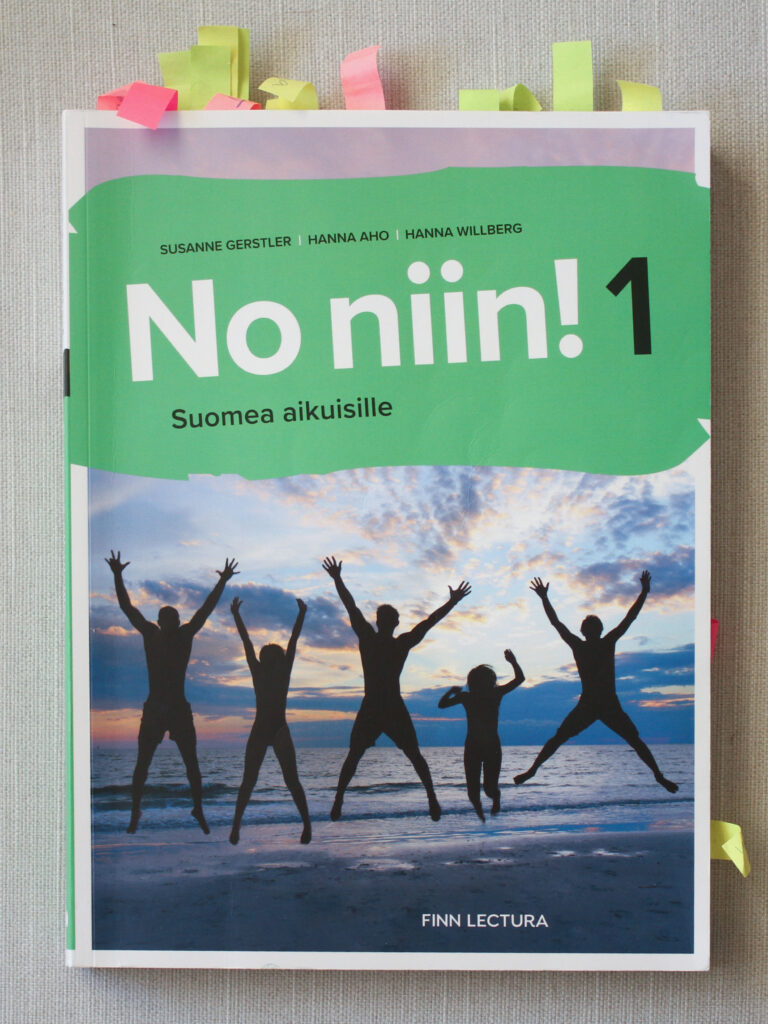
Materials We Used to Learn Finnish:
- Textbook
- “No Niin 1” by Susanne Gerstler, Hanna Aho, and Hanna Willberg
- Online learning platforms:
- Nova – digital version of “No Niin” with more exercises and practices.
- Moodle – mix of outside resources related to the chapter (videos, games, reading materials).
- Websites:
- Wordwall – user-generated games and flash cards.
- Osaan Suomea – website that tests your Finnish language level and knowledge.
From the time I joined the course until I left, we covered 9 out of 12 chapters of the textbook. We learned:
- Basics: alphabet, numbers, days, months, seasons, weather and time.
- Genitive Case
- Partitive
- Location Cases
- KPT Type 1 and 2
- Verb Types 1 – 6
- Passive Tense
- Tons of vocabulary
- How to talk about yourself – your name, age, address, your family, where you live, your hobbies, place you go to, and what you are doing in the present tense.
- Finnish culture, work life, government and general quirks.
My Personal Pros and Cons of the Integration Course:
My overall experience in the course was quite positive, but I would be lying if I said every class went great and I left feeling excited to continue learning Finnish.
Pros
I’ll start with my personal pros – these aspects are what kept me engaged in the course and helped keep me going.
Structure – I am someone who needs structure in my days to function like a normal human. Being unemployed in a foreign country has done a number on my mental health and the lack of real structure in my days was killing me. I loved that the class was every day and I wished it lasted longer than 4 hours.
Students – Not knowing or really speaking to anyone other than my husband and his family has been incredibly isolating. It was nice seeing people everyday and getting to work with people in the same boat as me. And even though we all came from different backgrounds, we were all able to bond and laugh about the struggle that is learning Finnish.
Progression – Without even realizing it, my Finnish skills improved tremendously from the time I started until I left. I can have very basic conversations with my husband, I can understand some of the signs that I see in town, I can read menus, and sometimes, I can eavesdrop on conversations. Who knew 20 hours a week of language lessons could actually teach you a language?
Cons
And now I’ll talk about the cons – these are aspects of the course that I found frustrating.
Busy work – This is probably my biggest issue with the course. Too often our teachers would spam the group chat with links to Wordwall games that we would complete individually and in silence. This felt like a waste of class time and could have been homework.
Speaking Finnish – The only times we actively spoke Finnish in our class was when we were in our small speaking groups. But too often, this felt like the blind leading the blind. There was no one to correct our mistakes or help us. And by the time Module 1 ended and even beyond, our speaking skills were really lacking.
Tests & Exams – For me, all of the tests and exams we had were a little too easy. I didn’t feel like I was actually being tested on what I knew. In fact, a lot of the time I felt like the teachers were afraid to really challenge us, especially on the Module 1 exam.
What You Should Consider Before Joining the Integration Programme
Before joining the course, keep in mind that the point of the TE integration course is for you to learn enough Finnish quickly so that you can get a job. You do have the opportunity to do two internships during the course which can be a good chance to network or get experience in a Finnish workplace. However, if you are like me and have no idea what you want to do now that you’re in Finland – this course won’t make that choice any clearer.
Also consider what kind of learner you are. Do you need more one-on-one time with the teacher? Do you learn better in smaller groups? If you struggle to learn and focus in large groups and require more support, I would suggest looking for your own Finnish course and checking with your TE coach to see if it will count towards integration.
How dedicated are you to learning Finnish? Even though the course is 20 hours a week, if you don’t pay attention in class and study on your own time – you will not learn Finnish. While the course is intensive, it moves quickly. And Finnish is a very difficult language to learn at first. Just sitting in on classes won’t teach you much if you do nothing to help yourself. I’ve seen it firsthand.
Do you prefer to learn in-person instead of online? As a self-professed homebody, even I struggled with feeling isolated while taking courses online everyday. The lack of human contact and in-person interaction was difficult, especially in the small speaking groups. Think about whether that will be an issue for you too.
Overall, this program is perfect for people who know what they want to do in Finland or have a career that they want to pursue, but just lack the Finnish language skills to do it. If this is you, don’t hesitate in joining the language programme. If you can land internships in your industry or previous job role – all the better.
But if you’re like me and have no idea what you want to do, I recommend taking time to think about what you want and whether learning Finnish will be helpful or a hindrance to that journey.
Final Thoughts
This was my experience with Tampere’s integration language program. Even though it took a long time to get into the course, I learned a lot in a short amount of time and I will always be grateful to Finland for providing foreigners this kind of opportunity.
While a part of me wishes that I stayed and finished the program, I’m glad I decided to focus more on my career. I’m still learning Finnish on my own and at university, just at a much slower pace. I realised that just taking Finnish classes full-time without a plan for the future wasn’t good for my mental health or personal growth. I felt like I was learning this big new skill and had no idea what to do with it.
If you’ve been through the integration course, let me know your thoughts below. Or if you’re currently enrolled, feel free to share your experience.
If you want to read more articles about living in Finland, head to the Life in Finland articles page for helpful guides and other articles!
You May Also Like:
 7 Steps for a Smooth Start After Moving to Finland
 Moving to Finland With Your Car: Steps, Considerations and More
 Apartment Hunting In Finland – Guide for New Arrivals
 Baking in Finland: Ingredients, Supplies, and More!
 11+ Things to Do in Tampere This Summer
 Driving in Finland: Must Know Rules & Considerations
Leave a Reply